
PU Adhesive for Rebond Foam
Single-component, moisture-cure modified-polyurethane adhesive (grades H-2301 / H-2401) for rebonded foam production — mixed with crushed foam, pressed and cured at room temperature or by steam into strong, resilient blocks for insole, sofa, mattress, carpet underlay and sports mats.
A binder built for regenerated-foam lines
PUGLUE rebond adhesive is a single-component, moisture-cure modified polyurethane (grades H-2301 / H-2401) that mixes evenly through crushed foam, gives a generous 25–30 min open time to fill the mold, and cures at room temperature in 3–5 h — or in just 10–14 min with steam at 120°C. The bonded sponge body has high strength, good toughness and resilience and bonds crushed foam of different densities. Recycle PU offcuts and trim into high-value foam at low cost.
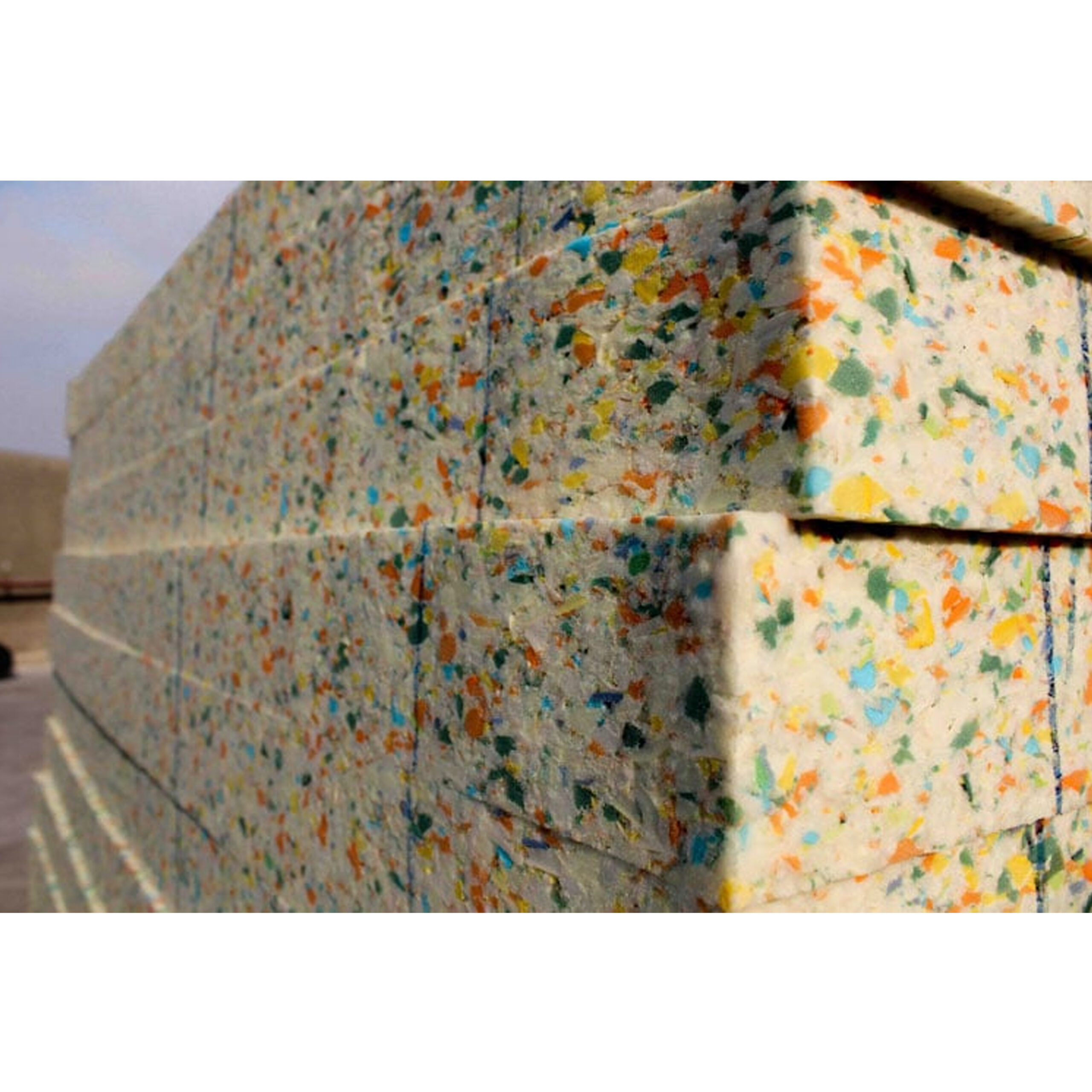
Turns Foam Scrap into New Blocks
One polyurethane binder recycles flexible-foam offcuts and trim into dense, resilient regenerated foam — cutting raw-material cost without losing performance.
Foam it rebonds
- Flexible PU foam offcuts & trim
- High-resilience (HR) foam scrap
- Memory / viscoelastic foam
- Mixed-color & mixed-grade crumb
End products
- Carpet underlay & cushion
- Mattress & furniture core
- Gym, sports & play mats
- Packaging & acoustic blocks
Process fit
- Mix glue evenly through crumb
- Compression-mold pressing
- Room-temp or steam cure
- Block then sheet / roll cutting
Types of Rebond Foam Adhesive — and Which to Choose
Regenerated foam is bonded with a few binder chemistries. PUGLUE supplies the single-component moisture-cure PU that dominates modern rebond lines, plus guidance on the alternatives.
| Binder type | Components | Best for | Notes |
|---|---|---|---|
| 1K PU (moisture-cure) | Single-component | Production rebond lines, all foam densities | Mixed through crumb; cures at room temp (3–5 h) or steam (10–14 min). PUGLUE H-2301 / H-2401. |
| Two-component PU | A + B | Special high-density or cold-cure jobs | Chemical cure, humidity-independent; needs metering. Available on request. |
| Latex / SBR emulsion | Water-based | Low-cost underlay | Cheaper but heavier, slower drying and lower resilience than PU. |
| Hot-melt | 1K | Niche / thin pads | Fast set but limited block thickness and resilience; not for structural rebond. |
Most rebond plants run a single-component moisture-cure PU — tell us your foam crumb and target density and we’ll match the grade.
Where PUGLUE Rebond Adhesive Is Used
From carpet underlay mills to mattress and sports-mat plants, PUGLUE binder turns recycled foam into high-value regenerated foam.
Carpet Underlay & Cushion
The classic rebond market — dense, resilient underlay rolls and cushion sheet that hold shape under foot traffic.
Mattress & Furniture Core
Firm, supportive cores and base layers for mattresses, sofas and seating — low-odor and resilient.
Gym & Sports Flooring
Shock-absorbing gym flooring, weight-room mats and fitness-room tiles in custom density.
Playground & Judo Mats
High-impact play mats, judo / martial-arts tatami and crash mats needing reliable resilience.
Packaging & Cases
Protective foam inserts, tool-case lining and cushioning blocks cut from rebonded sheet.
Acoustic & Insulation
Sound-absorbing panels and thermal / impact insulation where dense recycled foam performs.
Engineered Performance
Fast, flexible and economical — the profile rebond lines need to run efficiently.
High strength & resilience
The bonded sponge body has high strength, good toughness and resilience — not stiff or brittle.
Room-temp or steam cure
Cures at room temperature in 3–5 h, or accelerate with 120°C steam to just 10–14 min.
Works on every foam density
Strong, uniform bonding on crushed sponge of different densities — one adhesive for your full range.
Generous 25–30 min open time
Enough working time to mix glue and crumb evenly and fill the mold before cure starts.
How Rebond Foam Is Manufactured
PUGLUE adhesive fits the standard regenerated-foam process — from scrap to finished sheet.
Shred the scrap
Flexible-foam offcuts and trim are crushed into uniform crumb in a shredder.
Mix adhesive through crumb
Crumb and adhesive are blended thoroughly and evenly within the 25–30 min open time.
Press in the mold
Mixed crumb is filled into a mold and compressed to the target density block.
Cure, post-cure & cut
Cure at room temp (3–5 h) or steam (10–14 min); after 24 h post-cure the block is peeled / cut into sheet or roll.
Technical Parameters
Single-component moisture-cure PU — two standard grades. Values from the H-2301 / H-2401 datasheet.
| Property | H-2301 | H-2401 |
|---|---|---|
| Chemical base | Modified polyurethane (1K, moisture-cure) | Modified polyurethane (1K, moisture-cure) |
| Color & state | Light brown transparent liquid | Light brown transparent liquid |
| Viscosity (mPa·s, 25°C) | 110–160 | 80–120 |
| Non-volatile content | 70±2% | 65±2% |
| Open time (25°C) | 25–30 min | 25–30 min |
| Cure time (25°C) | 3–5 h | 3–5 h |
| Cure time (120°C steam) | 10–14 min | 10–14 min |
| Application temperature | ≥20°C recommended | |
| Packaging | 25 kg plastic drum / 220 kg galvanized iron drum | |
| Shelf life | 6 months (cool, dry, sealed) | |
Values from the H-2301 / H-2401 TDS — request the full datasheet for your process.
Open Time, Cure & Storage
Real figures from the H-2301 / H-2401 datasheet to plan your rebond run.
Open time
Working time at 25°C to mix glue and crumb evenly and fill the mold before cure.
Room-temp cure
Full cure at 25°C. Keep the application area above 20°C for best performance.
Steam cure (120°C)
Steam heating speeds cure dramatically — and improves the cured sponge body.
Shelf life
Store cool, dry and sealed — moisture-cure PU. Keep drums closed.
Engineered for Your Rebond Line
Batch-consistent supply matched to your crumb, blender and press.
Raw material screening
High-quality polyurethane raw materials from reliable feedstock — every batch meets spec.
Even crumb coating
Viscosity tuned (80–160 mPa·s) for uniform mixing through the crumb — no wet spots or dry cores.
Batch-to-batch consistency
Each lot tested so viscosity, cure speed and bond strength stay repeatable.
Line-matched supply
Reactivity and add-on rate matched to your press cycle, with TDS and trial support.
Equipment & Line Compatibility
PUGLUE rebond adhesive runs on standard regenerated-foam equipment — viscosity and reactivity matched to your blender and press.
Application methods
- Blender / mixer for even glue-crumb mixing
- Spray or pour onto tumbling crumb
- Single-component — no A:B metering
- Fill mold within 25–30 min open time
Compatible equipment
- Foam shredder / crusher
- Crumb blender / mixer
- Rebond press & block mold
- Steam curing chamber & peeling lathe
Line requirements
- Viscosity matched to spray nozzle
- Add-on rate matched to density target
- Steam supply for in-mold cure
- Dry, sealed adhesive storage
Running a new rebond line or upgrading an old one? Send us your press and target density — we’ll match viscosity and add-on rate.
A Manufacturer You Can Build On
A dedicated polyurethane adhesive manufacturer — not a trading reseller — supplying regenerated-foam plants worldwide since 2010.
Consistent, tested quality
In-house QC on every lot — tested viscosity, cure speed and bond strength, so your blocks come out uniform.
Full technical support
TDS, free trial samples and engineer support to match reactivity, add-on rate and target density to your line.
OEM & private label
Manufacturer-direct pricing, your branding, and stable supply for continuous production — no middleman.
Packaging, Samples & OEM Supply
Manufacturer-direct supply built around regenerated-foam procurement.
Packaging
25 kg plastic drum and 220 kg galvanized iron drum — trial quantities on request.
Free trial sample
Line-trial samples with full TDS so you can validate bond strength and density before committing.
OEM / private label
Your brand, your spec — manufacturer-friendly MOQ and repeatable batches.
Global export
Export-ready documentation and logistics support for overseas foam plants.
Frequently Asked Questions
Rebond / regenerated foam adhesive — technical answers for foam manufacturers.
What adhesive is used to make rebond (regenerated) foam?
A single-component, moisture-cure modified polyurethane — PUGLUE grades H-2301 and H-2401. It is mixed through crushed foam, which is then compressed in a mold and cured at room temperature or by steam into a strong, resilient block.
How is rebonded foam manufactured?
Flexible-foam scrap is shredded into crumb, blended thoroughly with the PU adhesive, compressed into a mold to the target density, then cured at room temperature (3–5 h) or by 120°C steam (10–14 min) and post-cured 24 h before cutting into sheet or roll.
What’s the difference between H-2301 and H-2401?
Both are single-component moisture-cure PU for rebond foam. H-2301 has higher solids (70±2%) and viscosity (110–160 mPa·s); H-2401 is lower (65±2%, 80–120 mPa·s). We help you pick the grade that suits your crumb and mixing method.
What foam scrap can be rebonded?
Flexible PU foam offcuts and trim, high-resilience (HR) foam, memory / viscoelastic foam, and mixed-color or mixed-grade crumb — recycling production waste into new product.
What density can the finished foam reach?
Density is customizable by how much crumb is compressed into the mold — from soft underlay up to firm, high-density blocks of 60 kg/m³ and above for sports, packaging and mattress use.
Does the adhesive harden or stiffen the foam?
No — it bonds the crumb at the contact points while leaving the foam soft, springy and resilient. The bonded sponge body has high strength and good toughness, not rigidity.
How long does it take to cure?
Open time is 25–30 min at 25°C. The block then cures in 3–5 h at room temperature, or in just 10–14 min with 120°C steam. Allow 24 h post-cure before cutting or processing.
Does the rebonded foam smell?
Odor is low — steam curing further drives off residual smell, so finished foam is suitable for mattress, sofa and furniture use.
What is the shelf life and how should it be stored?
6 months from manufacture when stored cool, dry and sealed. The adhesive is moisture-cure, so keep drums tightly closed against humidity.
Do you offer samples, TDS, MOQ and OEM supply?
Yes. We provide a full TDS, free samples for line trials, and OEM / private-label supply with manufacturer-friendly MOQs. Contact us for a quote matched to your crumb and target density.
The PUGLUE Grade for This Application
The matched adhesive grade for rebonded foam blocks.
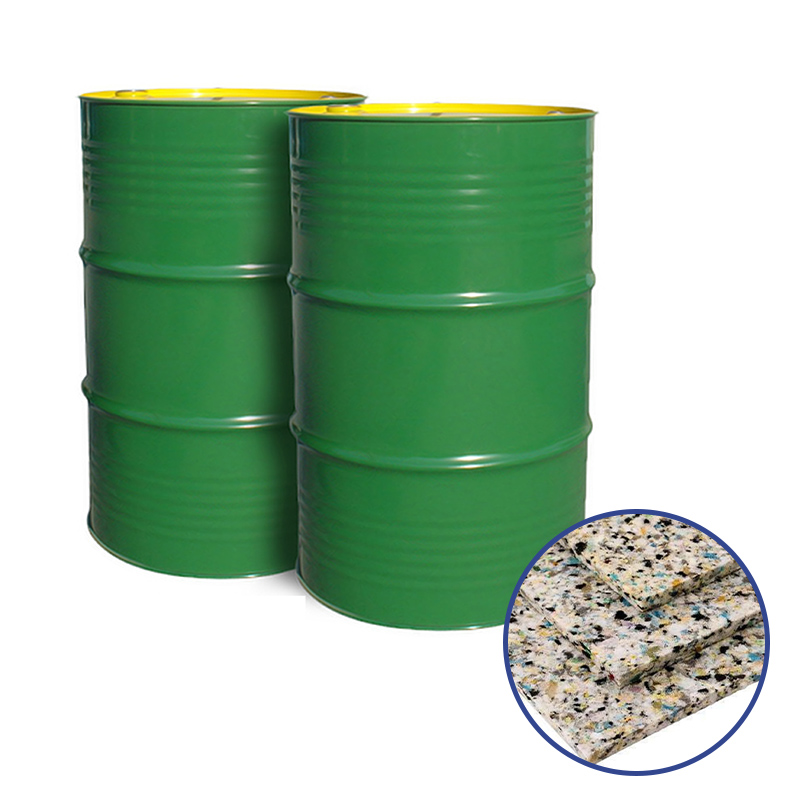
Rebond Foam PU Adhesive
Single-component moisture-cure polyurethane for rebonding foam scrap into blocks — the matched grade for rebonded-foam presses.
View Product Details →Related Adhesives & Guides
Matched polyurethane adhesives and technical resources for foam manufacturers.