Quick answer. Indonesian SNI 8 (tightened in 2024) requires fire-door cores to hold ≥ 90 min under fire test. If your current PU adhesive can't pass, you have to switch — but switching mid-production usually costs 2-3 weeks of line downtime and 20-30% capacity loss. The way out: parallel testing, not replacement. Five Indonesian fire-door OEMs ran our 4:1 PU adhesive in parallel with their existing supplier for 3 batches, validated SNI 8 compliance, and switched without stopping a single shift. Here's the protocol they used.
If you're a fire-door OEM in Indonesia — Java, Sumatra, anywhere — and your QA lead just told you the next SNI audit might fail, this is for you.
What changed in 2024 (and why your supplier may be quiet about it)
Indonesia's SNI 8 standard for fire-doors got stricter in 2024. The headline numbers:
- Burn time: ≥ 90 min (was 60 min for some sub-categories)
- Glueline integrity: bondline must hold without delamination during the entire test
- Smoke / toxicity: tighter limits
- Audit cadence: more frequent unannounced inspections at OEM sites
A lot of older PU adhesive formulations — especially generic 1K systems — pass the old standard but edge-fail under the new one. Glueline starts releasing at minute 65-75 instead of holding to 90+.
Your existing supplier knows this. Most aren't volunteering the news because:
- Reformulation is expensive on their side
- Telling you means you might switch anyway
- They hope your local SNI lab is lenient
We've seen Indonesian OEMs blindsided by this in the last six months — passing internal tests, then failing the SNI audit on a randomly pulled door from finished inventory. Once that happens, the fix isn't fast.

Modern SNI 8-rated steel fire door. The 90-minute burn test depends as much on the PU adhesive bonding the rockwool core to the steel skin as it does on the steel itself.
The real cost isn't the adhesive — it's the switch
Most procurement managers still think about adhesive cost as kg × $/kg. For a fire-door OEM, that's the wrong frame. The real cost stack when you switch suppliers looks more like this:
| Cost item | Typical range | Notes |
|---|---|---|
| Adhesive itself | 8-12% of door cost | The visible line |
| Line recalibration | 2-3 weeks of capacity at 50-70% | Different open time, viscosity, mix ratio |
| Operator retraining | 5-10 days at full attention | Especially if going from 4:1 to 5:1 or vice versa |
| First-batch QA risk | 5-15% scrap rate first 200 doors | Until process is stable |
| SNI re-test | $5-15k per re-test | If first batch doesn't certify cleanly |
| Customer contract risk | Variable, can be huge | If a downstream contract requires "no supplier change without notice" |
For a mid-size Java OEM doing 8,000 doors/month, the switching cost can run 80-200k USD before the new adhesive even becomes profitable. That's the real reason factory owners hesitate, even when they know their current adhesive is borderline.
This is also why "we'll send you a sample, just try it" — the standard sales pitch from most adhesive suppliers — falls flat with serious OEM buyers. You don't need a sample. You need a switch protocol that doesn't gamble production.
The parallel-test protocol (what 5 Indonesian OEMs actually did)
Of the five Indonesian fire-door OEMs that switched to our 4:1 system over the past 18 months, none stopped production to do it. The protocol:
Phase 1 (Week 1-2): Sample arrival, B-line allocation
- Sample arrives via DHL air, 3-5 days from China to Jakarta or Surabaya
- A small B-line (~10-15% of capacity) is set aside for parallel testing
- Main A-line keeps running existing supplier's adhesive — zero capacity disruption
Phase 2 (Week 3-5): Three parallel batches
- B-line runs three full batches with the new adhesive
- Each batch undergoes the same internal QA cycle: shear test, glueline inspection, accelerated aging at 70°C
- Critically, one door from each batch goes to the SNI-accredited lab — not just internal testing
- Our R&D engineer joins via video for each batch's data review (typically 30 min, ~$0 cost to the OEM)
Phase 3 (Week 6): SNI-equivalent burn test
- One full door from a B-line batch goes through a 90-min burn test at the local SNI lab
- This is the gating decision. If the door holds clean past 90 min, the formulation is validated.
- Of the five OEMs, four passed first try. One needed a viscosity adjustment for their specific rockwool core supplier — we shipped a customized variant within 14 days.
Phase 4 (Week 7-12): Gradual switchover
- B-line capacity grows from 15% → 30% → 50% → 100% over four weeks
- A-line wound down in parallel as old adhesive drum stock depletes
- By end of week 12, the entire OEM is running our adhesive — without a single shift lost
The total elapsed time is about 90 days. The total production hours lost across the entire switch: zero. The total operator retraining time: 2 days (because we ship Bahasa-language SOP videos).

Industrial PU adhesive applied during panel lamination on an OEM line. Bondline thickness, open time, and substrate prep set in this 30-second window determine whether the door passes its SNI 8 burn test six months from now.
What "passing SNI 8" actually requires from the adhesive
This is where most generic spec sheets are useless. SNI 8 doesn't directly test adhesive — it tests doors. But the adhesive determines about 60-70% of the door's behavior in fire test. The properties that actually matter:
Tensile shear at room temp: ≥ 7 MPa on rockwool / vermiculite cores. Below 6 MPa, the bondline starts releasing as soon as the foam core thermally expands. We test our 4:1 system at 7-8 MPa across multiple substrate pairs, with batch CoV (coefficient of variation) ≤ 3%.
Shear at elevated temperature: this is the hidden killer. PU adhesives that test fine at 25°C can drop 40-50% of shear strength at 80°C. The 4:1 we ship to Indonesian OEMs maintains ≥ 5.5 MPa at 80°C — the typical glueline temperature in the first 30 min of burn.
Char behavior: the bondline should char in place rather than ignite. Cheap PU formulations can off-gas under heat and accelerate flame spread. The right catalyst package and the right resin backbone matter.
Open time at tropical conditions: Jakarta runs 30-32°C and 75-85% RH most of the year. Adhesive open time at 25°C / 50% RH (the spec sheet number) is often 30-40% shorter at Jakarta conditions. You need a formulation tuned for tropical processing — or your line's just going to skin before close.
If your current supplier hasn't given you the elevated-temp shear data and the tropical open-time data, ask. The silence is informative.

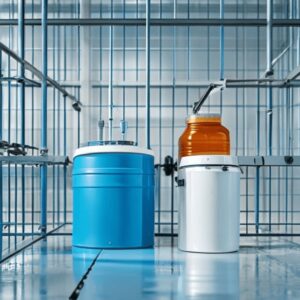
Two-component (4:1) PU adhesive packaged for industrial use. Component A and Component B mix at the metering pump, and the chemistry is on a clock from that moment until the press closes.
When NOT to switch
We're not in the "switch supplier at all costs" business. Honestly: don't switch if any of these apply.
- Your contract with current supplier locks you in for ≥ 12 more months, with significant penalties. Plan ahead, but don't break the contract — it'll hurt your relationships and credit.
- Your current adhesive demonstrably passes SNI 8 with margin (e.g., glueline holds to 105+ min in independent test). If it's working, leave it.
- You're under 1,000 doors/month and not exporting. The switching cost overhead doesn't pay back at low volume.
- Your line is calibrated for a very specific 5:1 ratio with custom dispensers that would cost $50k+ to recalibrate. The math may not work.
For everyone else — and that's the majority of Indonesian fire-door OEMs we've talked to — the math works. Some of those OEMs are export-oriented and stack BS 476 (UK) or EN 1634 (EU) on top of SNI. The same parallel-test protocol applies; just add a re-test cycle for each export market.
What we ship, plainly
Two industrial-grade two-component PU adhesive lines, both at 7-8 MPa structural shear:
- 4:1 ratio — industry default. Most existing Indonesian OEM lines run on dispensers calibrated for 4:1. Direct drop-in.
- 5:1 ratio — same final shear, slightly longer open time (~3-4 min more at 30°C), better suited for porous core variants.
Plus a 1K moisture-cured variant for low-volume retrofit work — but that's a small part of our shipments.
We also ship the glue-spreading machines that pair with these adhesives. About 60% of Indonesian OEM clients buy bundle (adhesive + machine); 40% retrofit our adhesive onto their existing dispenser. Both work.

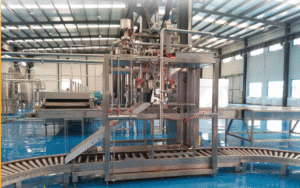
Our Jiangyin facility, where the 4:1 and 5:1 PU adhesive lines are formulated and QC'd. Customer factory tours include a walk-through of the production line, R&D lab, and accelerated aging test setup. Travel allowance available for serious B2B evaluators.
We don't have UL / FM Approved certification yet (that's a North American testing path, in progress). We have SNI testing data and partial EN 1634 data. If your export market requires UL specifically, we should talk before sample shipment — there are routes, but they take longer than just sending you a drum.
FAQ
Q: How long is the typical switching timeline from first sample to full production?
About 90 days for the full parallel-test protocol. First sample arrives in 3-5 days (DHL air). Three parallel batches take 4-5 weeks. SNI-equivalent burn test 1 week. Gradual switchover 4 weeks. None of this requires stopping the existing line.
Q: What if my current dispenser is calibrated for 5:1 but you ship 4:1?
Two options. We can ship a 5:1 variant of the same chemistry (same 7-8 MPa final shear, just metered differently). Or we can adapt our 4:1 to your dispenser's metering — our R&D engineer will work with your line's specific calibration. Tell us your dispenser model and we'll quote the path.
Q: Will the adhesive perform in Jakarta humidity (75-85% RH)?
Yes. Both our 4:1 and 5:1 are 2K (two-component) systems — the cure is independent of ambient humidity. (1K systems do struggle in tropical humidity swings, which is one reason we don't recommend 1K for high-volume Indonesian fire-door work.)
Q: How do I get the SNI 8 test reports?
After signing a brief one-page NDA, we send the redacted reports for our 4:1 line. Once we've started a sample arrangement, you can also see the full unredacted version. We don't post these publicly because they contain formulation hints competitors would value.
Q: Can your engineer actually come to my facility in Indonesia?
For first-batch validation, yes. We send an R&D engineer for 5-7 days, paying flight and accommodation. That covers the first three production batches end-to-end. Beyond that, we provide WhatsApp support and quarterly video reviews; emergency on-site within 72 hours if something goes wrong.
Q: What's the minimum order to start?
1,000 kg for first-time Indonesian customers. We've made exceptions for serious B-line trials at 500 kg, but 1,000 kg is what makes the protocol stable. Repeat orders are typically 3,000+ kg.
Want the parallel-test protocol PDF?
If you're an Indonesian fire-door OEM evaluating SNI 8 compliance, we have a free 12-page protocol PDF that lays out the entire parallel-test process: B-line allocation, batch QA checklist, SNI lab coordination, gradual switchover schedule. Plus the test method our 5 OEM clients used.
Request the protocol PDF + 500g sample — we ship within 48h, no obligation.
If you'd rather start with a 30-min technical call with our R&D engineer (Mr. [Name], 15 years PU adhesive R&D, fluent English, Bahasa via translator), book a slot here.
PUGLUE / Yongjia Polyurethane Co., Ltd ships PU adhesive and glue-spreading machines to fire-door OEMs in 12+ countries. Five Indonesian OEMs use our 4:1 system as their primary structural PU adhesive. Factory direct, MOQ negotiable for first-time validation. Headquartered in Jiangyin, China — visits welcome.
{
"@context": "https://schema.org",
"@type": "Article",
"headline": "How 5 Indonesian Fire-Door OEMs Passed SNI 8 Without Production Downtime",
"description": "Indonesian fire-door OEMs facing SNI 8 (2024) compliance: 4 ways to switch PU adhesive suppliers without stopping production. Real data from 5 OEMs.",
"datePublished": "2026-04-27T09:00:00+08:00",
"dateModified": "2026-04-27T09:00:00+08:00",
"author": {
"@type": "Organization",
"name": "SPC Team"
},
"publisher": {
"@type": "Organization",
"name": "SPC",
"logo": {
"@type": "ImageObject",
"url": "https://puglue.com/wp-content/uploads/2025/01/spc-logo.png"
}
},
"mainEntityOfPage": "https://puglue.com/indonesia-fire-door-sni-8-pu-adhesive-switch/",
"keywords": [
"polyurethane adhesive fire door indonesia SNI 8",
"PU adhesive SNI 8 compliance",
"fire door adhesive switching cost",
"4:1 polyurethane adhesive Indonesia",
"industrial PU glue manufacturer fire door"
],
"image": [
"https://puglue.com/wp-content/uploads/2025/03/fire-steel-door.jpg",
"https://puglue.com/wp-content/uploads/2025/03/Glue-is-applied-during-SIPs-panel-installation.-2025-03-10T110546.234Z-scaled.jpeg",
"https://puglue.com/wp-content/uploads/2024/05/adhesive-for-fire-door-1.jpg",
"https://puglue.com/wp-content/uploads/2023/05/fa759c36dd9847a2570da1aeabd36bf.jpg"
]
}
{
"@context": "https://schema.org",
"@type": "FAQPage",
"mainEntity": [
{
"@type": "Question",
"name": "How long is the typical switching timeline from first sample to full production?",
"acceptedAnswer": {
"@type": "Answer",
"text": "About 90 days for the full parallel-test protocol. First sample arrives in 3-5 days (DHL air). Three parallel batches take 4-5 weeks. SNI-equivalent burn test 1 week. Gradual switchover 4 weeks. None of this requires stopping the existing line."
}
},
{
"@type": "Question",
"name": "What if my current dispenser is calibrated for 5:1 but you ship 4:1?",
"acceptedAnswer": {
"@type": "Answer",
"text": "Two options. We can ship a 5:1 variant of the same chemistry (same 7-8 MPa final shear, just metered differently). Or we can adapt our 4:1 to your dispenser's metering — our R&D engineer will work with your line's specific calibration. Tell us your dispenser model and we'll quote the path."
}
},
{
"@type": "Question",
"name": "Will the adhesive perform in Jakarta humidity (75-85% RH)?",
"acceptedAnswer": {
"@type": "Answer",
"text": "Yes. Both our 4:1 and 5:1 are 2K (two-component) systems — the cure is independent of ambient humidity. (1K systems do struggle in tropical humidity swings, which is one reason we don't recommend 1K for high-volume Indonesian fire-door work.)"
}
},
{
"@type": "Question",
"name": "How do I get the SNI 8 test reports?",
"acceptedAnswer": {
"@type": "Answer",
"text": "After signing a brief one-page NDA, we send the redacted reports for our 4:1 line. Once we've started a sample arrangement, you can also see the full unredacted version. We don't post these publicly because they contain formulation hints competitors would value."
}
},
{
"@type": "Question",
"name": "Can your engineer actually come to my facility in Indonesia?",
"acceptedAnswer": {
"@type": "Answer",
"text": "For first-batch validation, yes. We send an R&D engineer for 5-7 days, paying flight and accommodation. That covers the first three production batches end-to-end. Beyond that, we provide WhatsApp support and quarterly video reviews; emergency on-site within 72 hours if something goes wrong."
}
},
{
"@type": "Question",
"name": "What's the minimum order to start?",
"acceptedAnswer": {
"@type": "Answer",
"text": "1,000 kg for first-time Indonesian customers. We've made exceptions for serious B-line trials at 500 kg, but 1,000 kg is what makes the protocol stable. Repeat orders are typically 3,000+ kg. ---"
}
}
]
}
{
"@context": "https://schema.org",
"@type": "BreadcrumbList",
"itemListElement": [
{
"@type": "ListItem",
"position": 1,
"name": "Home",
"item": "https://puglue.com"
},
{
"@type": "ListItem",
"position": 2,
"name": "Blog",
"item": "https://puglue.com/blog/"
},
{
"@type": "ListItem",
"position": 3,
"name": "How 5 Indonesian Fire-Door OEMs Passed SNI 8 Without Production Downtime",
"item": "https://puglue.com/indonesia-fire-door-sni-8-pu-adhesive-switch/"
}
]
}
Buying PU Adhesive for Manufacturing?
PUGLUE supplies industrial-grade polyurethane adhesives to fire-door OEMs, refrigerator manufacturers, SIP panel plants and cold-chain producers in 60+ countries. ISO 9001 plant in Jiangyin, China.
✓ Free 200 g sample
✓ 12–20 N/mm² shear · –40°C/+120°C
✓ Reply within 24 h