Why International OEMs Are Sourcing PU Adhesive from China in 2026
Three forces are pushing OEM buyers toward Chinese polyurethane adhesive manufacturers in 2026:
- Cost pressure — European and North American PU adhesive list prices for industrial-grade 2K systems sit 40–60% above qualified Chinese equivalents at container quantities, even after factoring in 25% Section 301 tariffs (US) or anti-dumping duties (EU).
- MDI capacity — Wanhua Chemical's Yantai and Ningbo MDI plants now account for ~30% of global MDI capacity, meaning the upstream raw material is structurally cheapest in Jiangsu / Shandong / Zhejiang adhesive formulators sitting near these MDI sources.
- OEM-grade quality has caught up — the gap between top-tier Chinese formulators and European brands on bond strength, cure consistency, and certification depth (ISO 9001, IATF 16949, REACH, RoHS) has closed for the majority of B2B applications.
But the risk side hasn't gone away: forged TDS / MSDS, COA fabrication, "small workshop" suppliers without QC labs, and bait-and-switch on bulk shipments are common enough that buyers need a structured verification process. This guide gives you the 12-point buyer checklist we wish every B2B procurement manager used before placing the first PO.
Quick Take
- Where the qualified manufacturers are: Jiangsu (江苏), Zhejiang (浙江), Shandong (山东), Guangdong (广东) — these four provinces account for >85% of OEM-grade PU adhesive output in China.
- What to verify, in order: ISO 9001 audit report → REACH SVHC declaration → 3-batch COA consistency → factory video tour or on-site visit → 2 customer references with same use case.
- What to ignore: glossy product brochures, "we are the largest" claims, list prices on Alibaba (always negotiable −20% to −40% at MOQ).
The 12-Point Verification Checklist
Real-world case: a 2025 Indonesian fire-door OEM consortium (5 manufacturers, ~22,000 doors/month combined) switched from European silicone-based adhesive to PUGLUE's 2K PU after running the 12-point checklist below — verified ISO 9001 audit reports, validated 3-batch COA consistency, completed factory video tour, then ran a 90-day pilot. First-pass SNI 8 certification rate moved from 92% to 99.5% post-switch.
1. ISO 9001 Certificate — verify the registrar, not just the cert number
A surprising number of "ISO 9001 certified" Chinese suppliers carry certificates from registrars that are not IAF MLA members — meaning the certification has no international recognition. Before you accept an ISO 9001 cert, check:
- The registrar name appears on IAF MLA member list
- Certificate number resolves on the registrar's online verification portal
- Scope of certification explicitly covers polyurethane adhesive manufacturing (not just "chemical products" or "trading")
- Audit date within the last 12 months
2. TDS — Look for ASTM / ISO / GB Test Method References
A real Technical Data Sheet cites the specific test method used for each property:
- Lap-shear strength → ASTM D1002
- Tensile strength → ASTM D412
- Cure rate → ASTM D5179 or in-house method with stated parameters
- Service temperature range → ISO 9142 thermal cycling
If the TDS just says "shear strength: 12 MPa" without a method reference, the number is meaningless. Push back.
3. MSDS / SDS — must follow GHS Rev 8+ format
The current global standard is GHS Rev 8 (2023). A compliant SDS has 16 sections in fixed order, includes UN classification for transport, lists the exact CAS numbers of the isocyanate (typically MDI: 101-68-8 or 5873-54-1; or polymeric MDI: 9016-87-9), and includes regulatory references for both the source country and destination country.
Red flag: SDS still in pre-2017 format, missing pictograms, or with isocyanate hazard statements removed. Walk away.
4. COA Consistency — Request 3 Recent Production Batches
A Certificate of Analysis (COA) is generated per-batch from QC test data. If you get the "same" COA template with identical numbers across 3 different batches, that's a fabricated document. Real COAs show:
- Batch number traceable to production date
- Numerical variance between batches within the spec window (typical: ±5% on viscosity, ±2% on solid content)
- QC inspector signature or stamp
- Dated within 30–60 days of shipment

5. REACH SVHC Declaration (Required for EU Buyers)
For shipments into the EU, the supplier must provide a REACH SVHC declaration confirming none of the Substances of Very High Concern on the current ECHA candidate list (242 substances as of late 2025) are present above 0.1% w/w. This declaration is updated whenever ECHA expands the list — typically twice a year. A one-time-issued REACH letter from 2022 is not sufficient.
6. Factory Video Tour or On-Site Audit
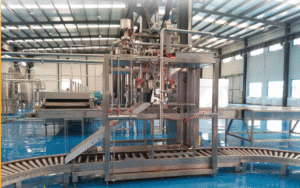
Every legitimate OEM-grade PU adhesive plant in China can produce a recent (last 6 months) video walkthrough showing:
- The MDI / polyol storage tank farm (typically nitrogen-blanketed for moisture protection)
- The reaction kettles or mixing vessels (typically 1,000–10,000 L)
- The QC laboratory with testing equipment for viscosity, NCO content, and tensile / shear bench
- The packaging line (cartridge, drum 200 kg, IBC 1,000 kg)
If the supplier hesitates, asks "why do you need this?", or sends a generic stock video — assume they are a trading company, not a manufacturer. Trading companies have their place but the price advantage of buying from China largely vanishes when you add a trading layer.
7. MOQ Tiers and Container Pricing
For PU adhesive, the typical MOQ tier breakdown for OEM-grade products:
| Tier | Quantity | Format | Indicative Lead Time |
|---|---|---|---|
| Sample | 200 g – 1 kg | Free | 5–7 days incl. courier |
| Pilot | 20–50 kg | Drum or pail | 10–14 days |
| Small batch | 1,000–5,000 kg | Drum (200 kg) or IBC (1,000 kg) | 14–21 days |
| Container LCL | 5,000–18,000 kg | Drum or IBC | 21–30 days |
| Container FCL 20'GP | 18,000–22,000 kg | Drum or IBC | 25–35 days |
| Container FCL 40'HQ | 22,000–26,000 kg | Drum or IBC | 25–35 days |
Pricing transparency check: ask for a quote at three different volumes (1,000 kg / 5,000 kg / FCL). The discount curve should be smooth and predictable, typically 5–8% step-down at each tier. If pricing is wildly nonlinear, the supplier is testing your knowledge.
8. Customer References — Same Use Case, Same Region
A supplier that says "we sell to 60+ countries" without naming any is hiding behind volume. Ask for two reference customers with the same use case as yours (e.g., "I'm a fire-door OEM, give me two fire-door OEM references in Southeast Asia") and follow up with at least one. A real customer will confirm whether the supplier shipped on time, whether the COA matched delivered material, and whether disputes (if any) were resolved fairly.
9. Shipping & Documentation Capability
For industrial PU adhesive, isocyanate-containing 2K kits ship as UN 2206 (Class 6.1) or similar dangerous goods classifications. The supplier must:
- Provide IMO Declaration of Dangerous Goods (DGD) for sea freight
- Have a DGR-certified packing partner (or in-house team)
- Issue HBL/MBL with consignee details that match your import paperwork
- Provide certificates of origin (CO), Form A, or specific FTA forms (RCEP / China-ASEAN / China-EU bilateral)
10. Payment Terms and Trade Compliance
Standard tier-1 OEM terms in China for first-time buyers: 30% T/T deposit on PO, 70% balance against B/L copy — or L/C at sight for higher-value orders. Suppliers asking for 100% upfront, or refusing L/C on > $50K orders, are operating on cash-flow distress and you should treat that as a risk signal.
11. After-Sales: Technical Service & Lab Time
The single biggest differentiator between top-tier Chinese formulators and commodity suppliers is the engineering response time on application questions. Test before you commit to a relationship:
- Send a non-trivial application question (e.g., "we're seeing edge debonding on 50 mm rock-wool sandwich panel after 90-day humidity aging — what's the root cause and recommended primer?")
- A qualified supplier responds within 24–48 hours with a detailed engineering reply, not "use more glue"
- Ask for lab-time access for joint testing — top suppliers will run your specific substrate combination on their lab benchtop within 1–2 weeks
12. Yongjiang Port Cluster Advantage (江阴优势)
The Jiangyin Yongjiang Port industrial cluster in Jiangsu province is the largest concentration of polyurethane formulator factories in China — co-located with Wanhua's MDI distribution, multiple polyol producers, and the dedicated dangerous-goods Yongjiang port. PUGLUE's plant operates inside this cluster, which translates to:
- 24-hour MDI / polyol replenishment with truck-direct delivery from Wanhua
- DGR-licensed export packaging on-site
- Consolidated container shipments from Yongjiang port to Hamburg, Rotterdam, Jakarta, Vladivostok, and Lima
See PUGLUE's industrial polyurethane adhesive product line →
What to Walk Away From
After auditing 200+ Chinese PU adhesive suppliers, here are the top warning signs:
- No physical address on the company website, only a P.O. box or "Hong Kong office"
- TDS / MSDS available only after PO — these are public commercial documents, not trade secrets
- "Patent-pending formulation" with no patent number — actual Chinese formulators carry CN patent numbers
- Product photos with competitor labels still visible, or watermark-mismatched images sourced from other suppliers' websites
- Excessive Alibaba badging (Gold Supplier 10+ years) without LinkedIn presence, factory phone, or named sales engineers
Frequently Asked Questions
Q: Can a Chinese PU adhesive really match BASF or Sika quality at 40% lower price?
A: For ~80% of B2B applications (sandwich panel, refrigerator gasket, fire-door OEM, SIP panel), yes — the formulation chemistry is published, raw materials are available, and the QC standards are achievable. For the other 20% (extreme high-temp aerospace, specialty automotive structural, specific UL-listed applications), the gap is real and you should pay for the brand premium.
Q: How do I verify a "famous" Chinese PU adhesive brand is actually the manufacturer?
A: Ask for the manufacturing license number (生产许可证) issued by the local Administration for Market Regulation. The licensee name on this document is the actual manufacturer. Many "brands" are marketing fronts for OEM contract manufacturing.
Q: What's a realistic timeline from first inquiry to first FCL shipment?
A: For a qualified buyer with clear specs: 5 business days to first technical reply → 10 days to free sample arrival → 3–4 weeks pilot batch test → 4–6 weeks first commercial PO → 4 weeks production + shipping. So roughly 90–120 days total from first inquiry to first container in your warehouse.
Q: Should I ask for an exclusivity agreement before placing my first order?
A: No. Exclusivity is a leverage tool earned with volume. Ask for a minimum-pricing-floor agreement instead — once you hit certain annual purchase tiers, the supplier commits to not undercut you on regional pricing.
Next Step
If you're sourcing industrial polyurethane adhesive for sandwich panel, fire-door, refrigerator, SIP, or cold-chain manufacturing, PUGLUE's engineering team can provide:
- Product TDS / MSDS / SDS aligned to your destination market regulations
- Free 200 g sample of the recommended grade
- Three-batch COA reference from recent production
- Container LCL / FCL pricing benchmark
- Technical engineering review of your specific substrate combination