By Michael Zhu, Senior Application Engineer
Quick answer. For cold storage panels and refrigerated truck bodies, specify a two-component polyurethane (2K PU) structural adhesive with a service range of roughly -40°C to +80°C, high peel and lap-shear strength on metal skins and PIR/PU foam cores, and verified resistance to thermal cycling and condensation. One-component moisture-cure PU works for continuous lamination lines, but 2K PU gives faster, temperature-independent cure and higher structural margins for load-bearing panels.
Why cold-chain panels are an adhesive problem, not just a foam problem
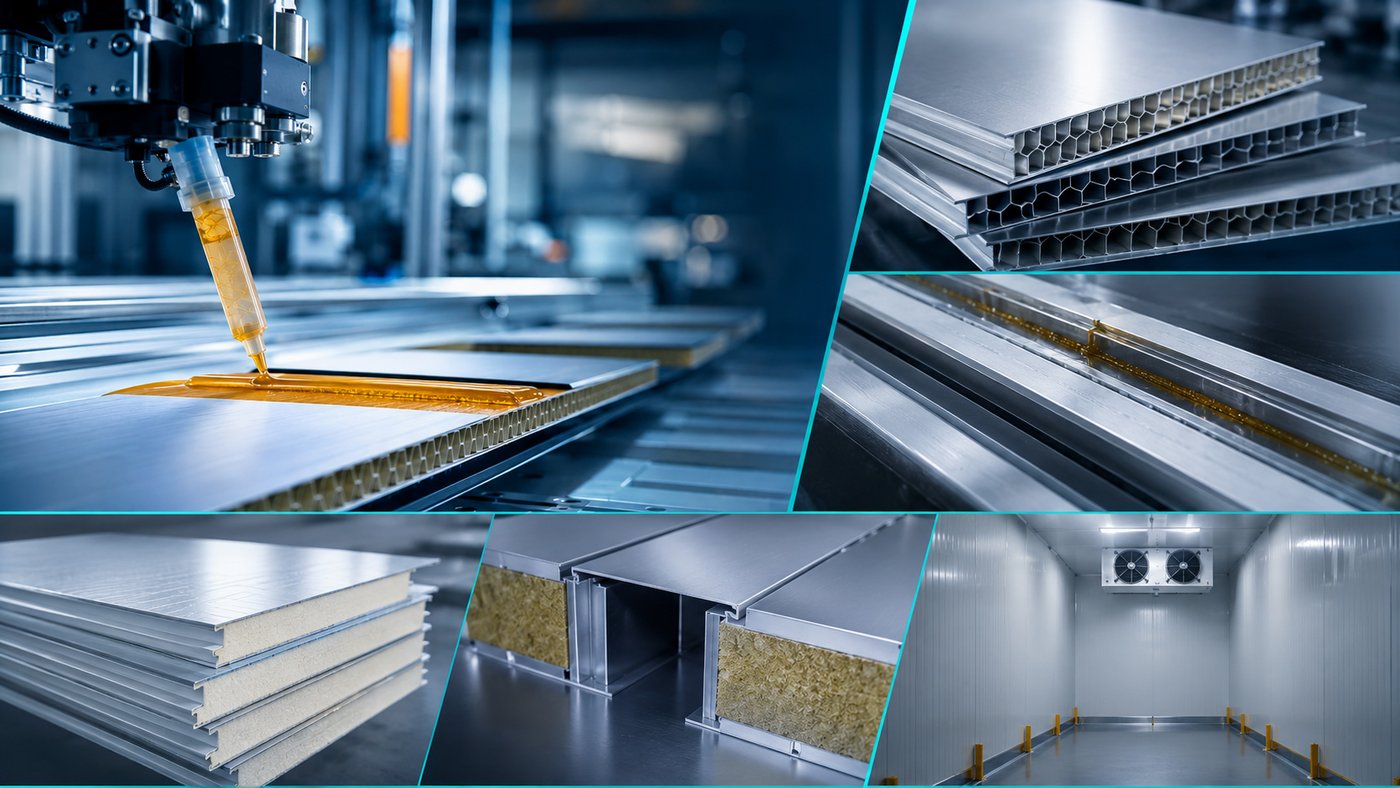
A refrigerated panel is a sandwich structure: two facings (galvanized or stainless steel, aluminium, GRP or FRP) bonded to an insulating core of polyurethane (PU), polyisocyanurate (PIR) or expanded polystyrene. The insulation stops heat transfer, but the adhesive is what holds the composite together for 10–15 years while it is repeatedly frozen, warmed during defrost cycles, vibrated over the road, and exposed to washdown chemicals. When a cold-store fails, the failure is almost never the foam — it is delamination at the skin-to-core bondline.
Because the bond sits across a steep temperature gradient, the adhesive must accommodate differential thermal movement between a metal skin at +30°C on a loading dock and a core interior at -25°C. Rigid, brittle chemistries crack; elastic PU adhesives distribute that stress. This is why polyurethane dominates cold-chain lamination and truck-body assembly.
The four properties that decide the specification
When our procurement customers send an RFQ for cold storage panel adhesive, we ask them to lock down four numbers before anything else:
- Service temperature window. Blast-freezer panels need continuous performance to -40°C; standard chillers only to -5°C. Over-specifying wastes money; under-specifying delaminates.
- Structural strength. Lap-shear and peel on the actual facing material, measured per ASTM D1002 (single-lap shear) and peel test methods, not a generic datasheet figure.
- Cure profile. Open time and full-cure time at your plant temperature. A 20-minute open time is useless if your press cycle is 8 minutes.
- Compliance. Food-contact indirect exposure, low-VOC, and correct handling of diisocyanate content under REACH — see the ECHA diisocyanates restriction.
PU adhesive types compared for cold-chain use
Three PU families cover almost every cold storage and refrigerated-truck job. The table below is the selection matrix we use with buyers.
| Property | 1K Moisture-Cure PU | 2K Structural PU | PU Hot-Melt (reactive) |
|---|---|---|---|
| Typical use | Continuous panel lamination | Load-bearing panels, truck bodies | Edge banding, profile wrapping |
| Service range | -30 to +80°C | -40 to +90°C | -20 to +70°C |
| Lap shear on steel (ASTM D1002) | 4–8 MPa | 8–15 MPa | 3–6 MPa |
| Cure driver | Ambient humidity | Chemical (temp-independent) | Cooling + moisture |
| Full cure | 24–72 h | 2–24 h | Minutes (handling) |
| Best for low-temp plants | Poor (needs humidity) | Excellent | Fair |
| Gap fill | High | High | Low |
For most walk-in coolers and refrigerated truck panels, buyers converge on 2K PU because its cure does not depend on ambient humidity — a real advantage in dry winter plants where 1K moisture-cure adhesives slow to a crawl. For high-throughput continuous double-belt lamination, 1K PU remains the volume workhorse.
Reading a datasheet like a procurement engineer
Marketing sheets quote peak strength on aluminium at 23°C. Cold-chain panels do not live at 23°C. Ask your supplier for three data points that most catalogs omit:
- Retained strength after thermal cycling. A credible cold-store adhesive keeps >80% of lap-shear strength after 50+ cycles between -40°C and +70°C. Peer-reviewed work on durability of polyurethane structural adhesives under thermal ageing shows how sharply under-formulated systems drop off.
- Peel strength, not just shear. Panels fail in peel at the edges first. A high shear number with weak peel is a delamination risk.
- Substrate-specific data. Bond to your exact facing — PVC-coated steel behaves nothing like bare galvanized. Demand a test on your coil.
If a supplier cannot produce cycled data on your substrate, treat the quotation as incomplete.
Refrigerated truck bodies: the harder case
A reefer body sees everything a cold-store sees, plus continuous road vibration, torsional flex of the chassis, and impact loads at the dock. That pushes the specification toward 2K PU with higher elongation-at-break (typically >150%) so the bondline can absorb dynamic strain without micro-cracking. Panel joints and floor-to-wall transitions also need a sealant-grade PU to block water and condensation ingress, which otherwise freezes, expands and jacks the bond apart. For truck-body assembly we normally pair a structural 2K PU for the panel laminate with an elastic PU sealant at the seams.
Certification and food-safety compliance
Cold-chain almost always means food or pharma logistics, so the adhesive is inside a regulated environment even when it never touches product directly. Buyers exporting to the EU and North America should confirm: low free-monomer diisocyanate content and REACH-compliant safety-data documentation, low-VOC formulation for enclosed installation, and where the panel forms part of a food storage envelope, evidence of suitability for indirect food-contact environments. Building an audit trail of these documents up front prevents a customs or customer-audit stoppage later.
Why buy adhesive direct from the manufacturer
Distributor-relabeled adhesive hides the one thing procurement needs: the real formulation and the ability to tune it. As a direct PU adhesive manufacturer, SPC supplies cold-chain panel and reefer-body customers with:
- Custom cure profiles matched to your press cycle and plant temperature — not an off-the-shelf compromise.
- Substrate-specific validation on your actual steel, aluminium or FRP coil before you commit to volume.
- Full compliance packs (SDS, REACH, VOC, food-contact statements) for export-market audits.
- Factory-direct pricing and MOQ flexibility, cutting the distributor margin out of a high-volume line item.
Cold storage panels are typically a sandwich / structural-insulated build, so start with our structural insulated panel (SIP) adhesive application page, then talk to us about a cold-chain-graded variant for your temperature window.
FAQ
Q: What is the best adhesive for cold storage panels?
A two-component polyurethane structural adhesive rated from roughly -40°C to +80°C with verified thermal-cycling durability. It bonds metal facings to PU/PIR cores, cures independently of ambient humidity, and delivers the peel strength that resists edge delamination.
Q: Can I use the same adhesive for a refrigerated truck body and a static cold room?
Often the same 2K PU family, but the truck version needs higher elongation-at-break to survive road vibration and chassis flex, plus an elastic PU sealant at the seams. Confirm the dynamic-load data before reusing a static-panel spec.
Q: Will PU adhesive cure at low plant temperatures?
Two-component PU cures chemically, so it works in cold, dry plants where one-component moisture-cure adhesives stall. Open time and full-cure time still lengthen as temperature drops, so request the supplier's cure curve at your actual line temperature.
Q: How do I verify an adhesive won't delaminate over 10 years?
Ask for retained lap-shear and peel strength after 50+ thermal cycles between -40°C and +70°C, tested on your exact facing material per ASTM methods. A quality cold-chain adhesive keeps over 80% of its original strength after cycling.
Q: Is PU adhesive food-safe for cold storage?
Fully cured PU adhesive used inside the panel structure is suitable for indirect food-contact environments when the supplier provides REACH, low-VOC and food-contact suitability documentation. Always keep that compliance pack on file for customer and customs audits.
Related: Polyurethane vs Epoxy Adhesive: B2B Selection Guide
Related: PU Glue for Color-Steel Sandwich Panels: A Bonding & Selection Guide
Related: Polyurethane Construction Adhesive: An Industrial Selection Guide for B2B Buyers