By Michael Zhu, Senior Application Engineer
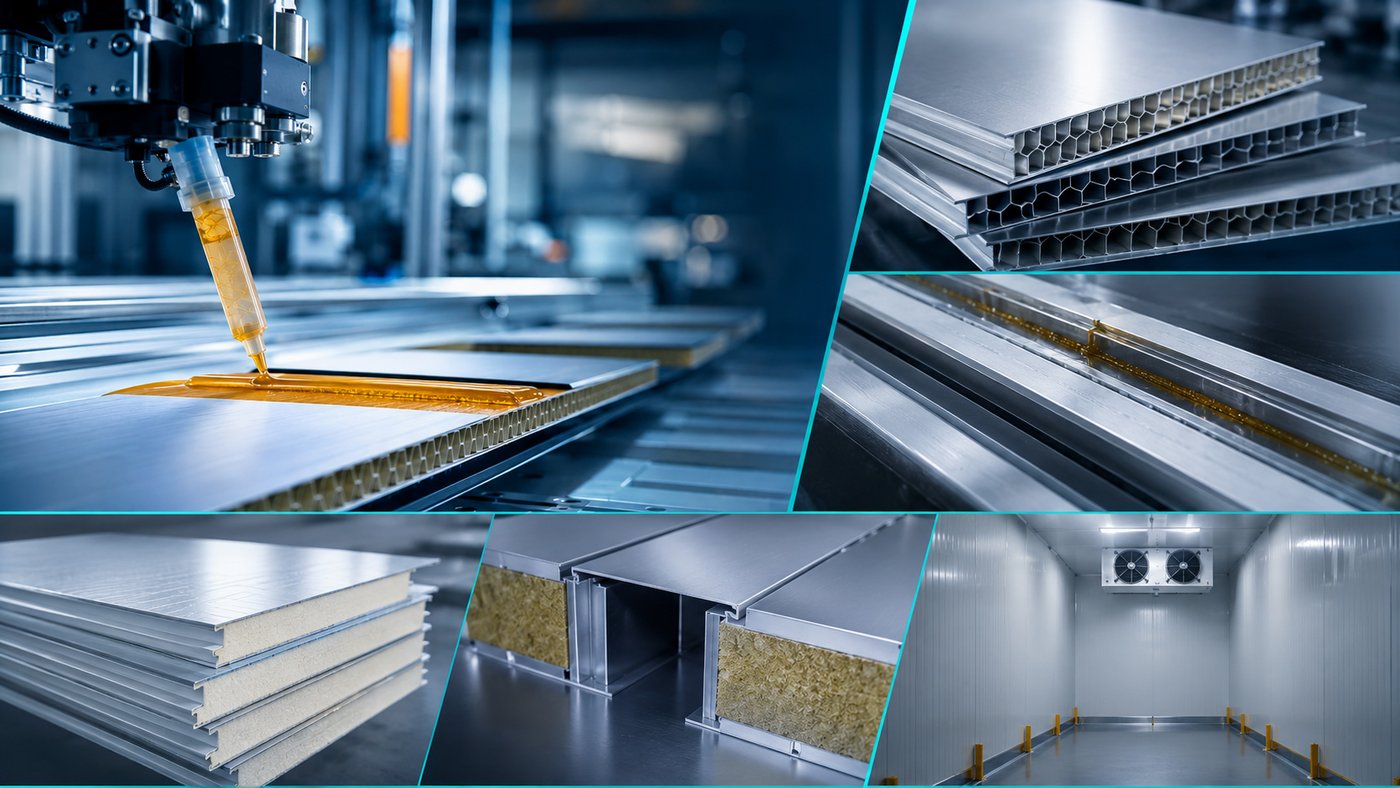
Quick answer. Sandwich panel delamination is the loss of adhesion between a facing (metal, HPL, FRP, or wood skin) and the core (PU/PIR foam, mineral wool, honeycomb, or XPS). It is almost always caused by one of five factors: an under-specified or mismatched adhesive, poor surface preparation, incorrect open time and press pressure, moisture or thermal cycling, or dimensional stress from mismatched thermal expansion. Prevent it by matching a certified structural adhesive to the substrate pair, controlling glue spread and cure, and verifying the bond with peel and climbing-drum testing before shipment.
For panel fabricators, delamination is the single most expensive field failure. A blister, an edge lift, or a full facing separation rarely shows up on the production line — it appears months later on a customer’s roof, cold-room wall, or curtain-wall assembly, where the cost of replacement is 10–50× the cost of the adhesive that failed. This guide breaks down why sandwich panels delaminate and the specific controls a B2B buyer should demand from their adhesive supplier and their own process.
What delamination actually is (and where it starts)
A sandwich panel works structurally only if the facings and core act as one composite: the skins carry tension and compression, the core carries shear, and the adhesive bond line transfers that shear between them. When the bond line fails, the panel loses most of its bending stiffness and load capacity — even though the skins and core look intact. That is why delamination is a structural defect, not a cosmetic one.
Failure begins at the weakest interface. In practice, engineers classify the failure mode by where the crack runs, because the location tells you the root cause:
- Adhesive failure — the glue separates cleanly from a facing or the core. Points to surface prep, contamination, or wrong adhesive chemistry.
- Cohesive failure — the adhesive tears within itself, leaving glue on both sides. Points to under-cure, wrong mix ratio, or an adhesive stressed beyond its strength.
- Substrate failure — the foam or facing tears while the bond holds. Usually acceptable; it means the adhesive is stronger than the core.
A good QC program logs the failure mode on every peel coupon, because “the panel delaminated” is useless data — “adhesive failure at the metal skin” tells you exactly what to fix.
The five root causes of sandwich panel delamination
1. Under-specified or mismatched adhesive
The most common root cause is chemistry. A one-component PU that bonds steel-to-PIR beautifully may not wet out a low-surface-energy FRP or a pre-painted galvanized skin with a silicone-modified topcoat. Buyers who select on price alone often get an adhesive with adequate green strength but poor long-term resistance to the panel’s real service environment — heat, humidity, or continuous static load.
2. Poor surface preparation and contamination
Mill oil on steel, mold-release agents on FRP, dust on cut foam edges, and condensation on cold skins all create a weak boundary layer. The adhesive bonds to the contaminant, not the substrate, and peels cleanly months later. Surface energy matters: many plastics and coated metals need corona, flame, or primer treatment to reach a wettable surface.
3. Incorrect process window — open time, spread, and pressure
Moisture-cured PU adhesives skin over if open time is exceeded before the panel is closed, so the two halves never fuse. Too little glue starves the joint; too much can foam excessively and push the skins apart. Insufficient or uneven press pressure leaves voids where the facing never contacted the adhesive. Each of these is a controllable process variable, not bad luck.
4. Moisture ingress and thermal cycling
Water at the bond line hydrolyzes some adhesives and freezes-expands in others. Panels installed on roofs or in cold rooms see daily thermal cycling; each cycle loads the bond line as the metal skin expands and the core does not. Over thousands of cycles, a marginal bond fatigues and lets go at the edges first.
5. Differential thermal expansion and mechanical stress
A dark metal facing can reach 80°C in sun while the shaded back skin stays at 25°C. The resulting bow puts continuous peel stress on the bond. If the adhesive is too rigid to accommodate this movement, it cracks; a slightly elastomeric structural adhesive absorbs the strain and survives. Reference frameworks like the composite-materials guidance summarized on ScienceDirect’s sandwich panel topic pages reinforce that skin-core stress transfer is the governing design consideration.
How to prevent delamination: the adhesive selection matrix
Prevention starts at specification. The table below maps common facing/core pairs to the adhesive chemistry that gives the widest process window and the best long-term durability. Treat it as a starting point for a bonded test panel, not a substitute for one.
| Facing → Core | Recommended chemistry | Key control point | Typical peel target |
|---|---|---|---|
| Pre-painted steel → PIR / PU foam | 1K moisture-cure PU | Open time & even spread (120–200 g/m²) | ≥ foam substrate failure |
| Aluminum → aluminum honeycomb | 2K epoxy or film adhesive | Press pressure & flat platens | ≥ 5 N·mm/mm climbing drum |
| FRP / GRP → PU or balsa core | 2K PU or primed 1K PU | Surface prep + primer on FRP | Cohesive in core |
| HPL / wood skin → XPS / PU | 1K PU or PVAc for interior | Moisture content of wood <12% | ≥ skin fiber tear |
| Steel → mineral wool | 2K PU (high wet-out) | Wool surface dust removal | ≥ wool cohesive |
Notice that the target in every row is a substrate or cohesive failure, never an adhesive failure. If your bonded coupons peel clean at the glue line, the specification is wrong — no amount of process tuning will save it.
Process controls that keep the bond line intact
Once the chemistry is right, delamination becomes a process-discipline problem. The controls that matter most on a continuous or discontinuous panel line are:
- Substrate readiness — degrease coated metals, remove foam-cut dust, verify skins are above dew point so no condensation forms, and prime low-energy plastics.
- Glue spread verification — weigh coat weight per square meter at the start of every shift; a roller wearing out slowly starves the joint before anyone notices.
- Open time discipline — track the time from application to press close against the adhesive’s data sheet, adjusting for line temperature and humidity.
- Press pressure and dwell — uniform pressure across the full platen; map for cold spots and edge lift where pressure drops.
- Cure confirmation — do not cut, stack, or handle until the adhesive has reached handling strength; premature stress on a green bond is a classic edge-delamination cause.
Occupational controls matter too: isocyanate-based PU adhesives require ventilation and PPE per the exposure guidance published by OSHA on isocyanates, and any adhesive used in EU-bound panels must be checked against restricted-substance requirements under ECHA’s REACH framework. A compliant supply chain is part of a defect-free bond.
Quality control: prove the bond before you ship
You cannot inspect delamination resistance visually — you have to test it. A robust incoming and in-process QC program uses destructive coupons plus non-destructive screening:
- Climbing-drum peel for honeycomb and rigid cores, following the method family in ASTM D1781.
- Flatwise tensile to measure through-thickness bond strength on foam-core panels.
- Tap test or ultrasonic scan as a fast non-destructive check for voids and blisters before pack-out.
- Accelerated aging — humidity and thermal-cycle chambers to simulate years of service in weeks, so a marginal bond fails in the lab, not on the customer’s building.
Test standards and terminology should trace back to recognized bodies such as ASTM International, which keeps the methods repeatable across suppliers and auditors. Documented, standard-based QC is also what your own B2B customers’ engineers will ask to see during vendor qualification.
Why a certified manufacturer-direct adhesive supplier reduces your risk
Delamination is a supply-chain problem as much as a chemistry problem. Buying certified structural adhesive direct from the manufacturer — rather than through a repacker — gives you three advantages that map directly onto the five root causes above: (1) a formulation tuned to your exact facing/core pair instead of a generic grade, (2) batch consistency with traceable QC data you can audit, and (3) application-engineering support to lock in the open time, spread, and cure window for your line.
As a factory-direct PU and structural adhesive producer, Puglue formulates and tests panel-bonding adhesives for the substrate combinations in the matrix above, supplies the technical data sheets and REACH/compliance documentation your customers require, and can customize green strength and open time to match line speed. Explore our structural insulated panel (SIP) adhesive solutions or contact our engineers for a bonded test-panel program before you commit to a production grade.
FAQ
Q: What is the most common cause of sandwich panel delamination?
The single most common root cause is an adhesive that is under-specified or mismatched to the facing/core pair, followed closely by poor surface preparation. Both produce clean adhesive-line failures that appear weeks or months after production, once thermal and moisture cycling loads the bond.
Q: How can I tell whether it is an adhesive problem or a process problem?
Look at the failure surface on a peel coupon. Glue on both substrates (cohesive) or torn foam/skin (substrate) points to a process or over-stress issue; a clean, glue-free interface (adhesive failure) points to wrong chemistry or contaminated surfaces. Logging the failure mode on every test is the fastest diagnostic.
Q: Which test confirms a panel will not delaminate in service?
No single test does, but climbing-drum peel (ASTM D1781 family) and flatwise tensile establish the as-built bond strength, while accelerated humidity and thermal-cycle aging predict long-term durability. Run all three during vendor qualification and periodically in production.
Q: Does moisture really cause delamination on a sealed panel?
Yes. Water reaches the bond line through cut edges, fastener penetrations, and condensation from thermal bridging. It can hydrolyze susceptible adhesives and freeze-expand at the interface. Edge sealing, a hydrolysis-resistant PU chemistry, and controlled skin temperature during bonding all reduce the risk.
Q: Can I prevent delamination by simply using more adhesive?
No — over-application often makes it worse. Excess moisture-cure PU can foam and push the skins apart, and it wastes cost. The goal is uniform coverage at the specified coat weight with full skin contact under press pressure, not maximum glue volume.
Q: Why buy adhesive direct from the manufacturer instead of a distributor?
Manufacturer-direct supply gives you a grade formulated for your specific substrate pair, auditable batch QC data, compliance documentation for export, and application-engineering support to set your open time, spread, and cure window — the exact controls that prevent delamination.
Related: Sandwich Panel Adhesive: A B2B Selection Guide
Related: Sandwich Panel Adhesive: PU Bonding Guide for OEMs
Related: Adhesive for OSB Panels: Bonding SIP & Sandwich Panel Skins