Buying XPS / EPS foam board adhesive in bulk? PUGLUE is a factory-direct PU adhesive manufacturer — OEM supply, free samples and full TDS for industrial buyers.
Looking for the right adhesive for XPS and EPS foam boards? Selecting the best polyurethane adhesive ensures strong, lasting bonds while maintaining foam integrity. Dive into our expert guide to discover the ideal polyurethane adhesive solution tailored to your needs.

Why Is Choosing the Right Adhesive Important for XPS and EPS?
Choosing the wrong adhesive can ruin your project—melting, weakening, or simply not adhering properly to the foam. XPS (Extruded Polystyrene) and EPS (Expanded Polystyrene) foam boards require specialized polyurethane adhesives formulated specifically to prevent damage and ensure lasting performance.
What Is Polyurethane Adhesive for Foam Boards?
Polyurethane adhesive (PU glue) is a versatile and powerful adhesive known for its reliable, durable, and waterproof bonding capabilities. It cures by reacting with moisture in the environment, producing a strong chemical bond without damaging sensitive insulation foams like XPS and EPS.
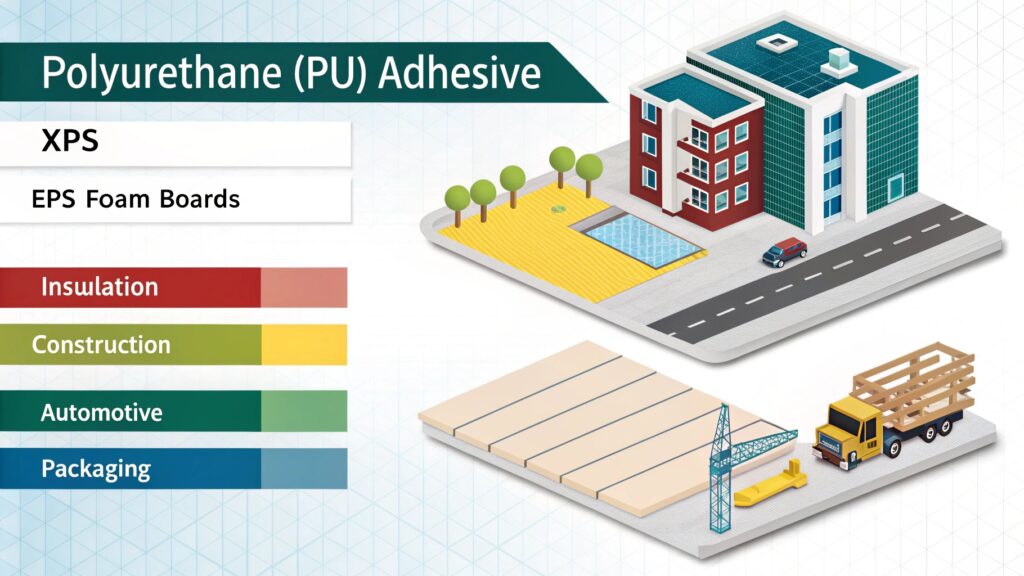
Common Application Areas for PU Adhesive with XPS and EPS Foam Boards:
- Insulation panel installation (walls, roofs, floors)
- Architectural foam details and moldings
- Exterior Insulation and Finish Systems (EIFS)
- Model-making and prototypes
- Refrigeration systems and freezers
- Marine, RV, and automotive insulation setups
How Does Polyurethane Adhesive Work with Foam Boards?
Polyurethane glue sets in a clear, step-by-step curing process:
- Surface Preparation: Ensure foam surfaces are clean, dry, and dust-free.
- Application: Apply the polyurethane adhesive evenly on one foam side—typically as foam beads or parallel lines.
- Joining Surfaces: Press foam boards firmly together within the adhesive’s open curing time (typically 10–20 minutes). Hold or clamp securely.
- Curing Stage: PU adhesive reacts with moisture and expands slightly to fill gaps, curing completely in roughly 4–6 hours.
- Final Strength: Achieves maximum bonding strength in 24 hours, providing unmatched durability and stability.
Tip: Proper ventilation and adequate protection equipment (gloves and mask) are recommended during application.
Learn more about applying PU adhesives by watching this instructional video
Comparing Polyurethane vs. Epoxy vs. Silicone Adhesives for Foam
The right adhesive can significantly influence your project’s durability:
| Feature | Polyurethane Glue | Epoxy Resin | Silicone Adhesive |
|---|---|---|---|
| Flexibility | ✅ High flexibility | ❌ Rigid Adhesion | ✅ Moderate flexibility |
| Foam Compatibility | ✅ Excellent (XPS & EPS) | ⚠️ Can damage foam | ⚠️ May not adhere well |
| Expansion | ✅ Expands slightly | ❌ No expansion | ❌ Minimal expansion |
| Waterproof | ✅ Waterproof | ✅ Resistant | ✅ Water-resistant |
| UV Resistance | ✅ Good resistance | ⚠️ Limited | ✅ Excellent |
Clearly, polyurethane adhesive offers significant advantages specifically for bonding XPS and EPS foam boards.
Top Benefits of Using Polyurethane Adhesive for Foam Applications:
- Foam-Friendly Formulation: Specifically designed not to damage XPS and EPS.
- Excellent Insulation Properties: Maintains the thermal insulating performance of foam boards.
- Strong Bonding Power: Proven strength for long-term durability.
- Moisture-Resistance: Protects insulation panels from moisture ingress and mold.
- Ease of Use: Simple application process with minimal training required.
Recommended Industries That Benefit from PU Adhesives:
Industries enjoying immense advantages include:
- Construction: Reliable insulation installation and efficient building envelopes.
- Refrigeration & Cold Storage: Durable, moisture-resistant bonding suited for temperature extremes.
- Marine and Automotive: Provides lightweight insulation solutions essential for vehicle efficiency.
- Architecture & Decoration: Enables creative design freedom without compromising structural integrity.
Proven Trust and Reliability Backed by Data and Certification:
At PUGlue.com, our polyurethane adhesives are:
- Certified by internationally recognized standards (ISO 9001, ISO 14001, CE certified).
- Chosen by industry-leading enterprises in construction, refrigeration, and automotive sectors.
- Providing robust bonding efficiencies, boasting precision performance (mixing accuracy ±1%), and annual production capability exceeding 50,000 tons.
According to a Market Report by MarketsandMarkets, “The polyurethane adhesive market continues to grow significantly, driven by construction and insulation sectors leveraging its superior adhering properties for foam-based insulating materials, notably XPS and EPS.”
Why Trust PUGlue.com for Your Foam Board Adhesive Solutions?
We combine expertise, reliability, and performance to ensure you get the best polyurethane adhesive tailored to your project needs. Our professional team is always ready to help you determine precise requirements and guide you through product selection and application.
Explore other adhesive solutions in our detailed blogs
Conclusion: Why Polyurethane Adhesives Stand Out for XPS/EPS Foam Boards
Choosing polyurethane adhesive provides unmatched security and effectiveness for projects involving XPS and EPS foam boards. It offers excellent compatibility, high flexibility, exceptional durability, and superior water-resistance.
Take the next step—contact us today for a customized consultation. Enhance your foam board applications with adhesives trusted by global experts.
Bonding EPS or XPS foam boards into structural panels? See our PU adhesive for SIP & sandwich panels — a two-component lamination system engineered for production panel lines.
EPS-Specific Bonding: Where It Differs From XPS
Most guidance lumps XPS and EPS together, but on the line they behave differently. EPS (expanded polystyrene) is moulded from fused beads: its surface is more open and slightly absorbent, its common densities run lower, and inter-bead voids mean an adhesive must bridge, not just wet. XPS (extruded polystyrene) is closed-cell with a smoother, denser skin. Three EPS-specific rules follow:
- Solvent-free is not optional. Solvent-borne adhesives attack polystyrene, and EPS with its open bead structure is even more vulnerable than XPS skin. Our PU grades for foam boards are solvent-free polyurethanes – nothing in the glue line to dissolve the bead matrix.
- Feed the surface. On open-surface EPS batches, apply toward the upper end of the coating-weight range so the bond line stays fed after the beads take their share; a starved line shows up later as bead pull-out along the joint.
- Judge the joint by substrate failure. A correct EPS bond fails in the foam, tearing beads away – if the glue line peels clean, the problem is coverage or surface dust, not adhesive strength.
Grade selection, coverage figures and the TDS download are on the XPS & EPS board adhesive application page; for phenolic and other rigid insulation boards see the phenolic foam board adhesive.
Watch the test: 2K PU glue bonding an MGO+XPS+MGO panel sample.
Frequently Asked Questions About XPS & EPS Foam Adhesive
What is the best glue for XPS foam?
The best glue for XPS foam is a solvent-free, moisture-curing polyurethane (PU) adhesive. Solvent-borne glues can attack the closed-cell polystyrene skin, while PU adhesive bonds without dissolving it, expands slightly to fill small gaps, and stays flexible after curing. Open time is typically 10–20 minutes, with full handling strength reached in about 24 hours.
What is the best adhesive for EPS foam?
For EPS (expanded polystyrene), solvent-free PU adhesive is not optional – EPS is moulded from fused beads with a more open, absorbent surface than XPS, so a solvent-borne glue is even more likely to dissolve the bead matrix. Apply toward the upper end of the coating-weight range so the bond line stays fed after the beads absorb their share.
What is EPS glue and how does it differ from XPS glue?
“EPS glue” and “XPS glue” usually refer to the same family of solvent-free polyurethane adhesives, but application differs by substrate. XPS is closed-cell with a smoother, denser skin and needs less coverage; EPS’s open bead structure needs more coverage so the joint doesn’t starve. A correctly bonded EPS joint fails inside the foam (bead tear-out) rather than peeling clean off the surface.
What is XPS foam adhesive?
XPS foam adhesive is a polyurethane glue formulated to bond extruded polystyrene without melting or weakening it – unlike many solvent-based contact cements or some epoxies that can damage the foam. It cures by reacting with ambient moisture, forming a waterproof, UV-resistant bond suited to insulation panels, EIFS, and architectural foam details.
What is the best adhesive for an XPS foam board?
For XPS foam board, a two-component or moisture-cure polyurethane adhesive gives the best combination of bond strength, flexibility, and water resistance. Grade selection, coverage figures (g/m²), and TDS downloads for board-specific applications are on our XPS & EPS board adhesive application page.
Can I use polyurethane adhesive for expanded polystyrene (EPS) insulation boards?
Yes. Polyurethane adhesive is the standard choice for EPS insulation boards because it is solvent-free (safe for the foam), moisture-resistant, and maintains the board’s thermal insulating performance after bonding – unlike solvent-based adhesives, which can shrink or eat into the polystyrene.
How long does XPS/EPS foam adhesive take to cure?
Open/working time is typically 10–20 minutes after application. The adhesive cures enough to handle in roughly 4–6 hours and reaches maximum bond strength at about 24 hours. Proper ventilation speeds moisture-cure; cold, dry conditions slow it down.